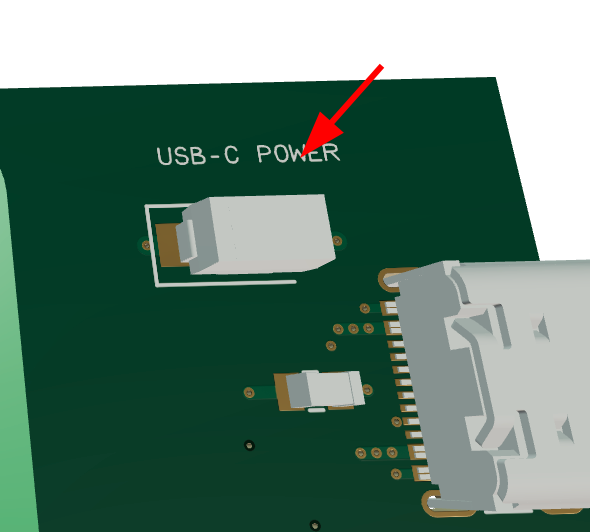
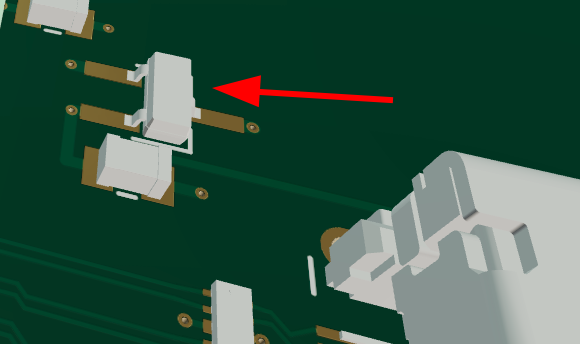
does this sound correct? ```The arrows appear to point to D1, the input protection diode, and U1, the HDMI power switch. Both are present in the circuit and BOM, but use generic package models. tsci search found their exact JLCPCB parts; I’m importing those and checking pin numbering before using them.```
```His questions are reasonable. Two layers may be feasible, but we haven’t established that this design will meet its HDMI requirements on two layers.
Four layers were chosen to give the HDMI traces a nearby, continuous ground plane and provide separate 5 V distribution. Raspberry Pi specifies 100 Ω differential HDMI routing. Our trace dimensions were calculated for the current four-layer stack-up; converting to two layers requires recalculating that geometry and rerouting power and return paths. It isn’t simply removing two layers. CM5 datasheet
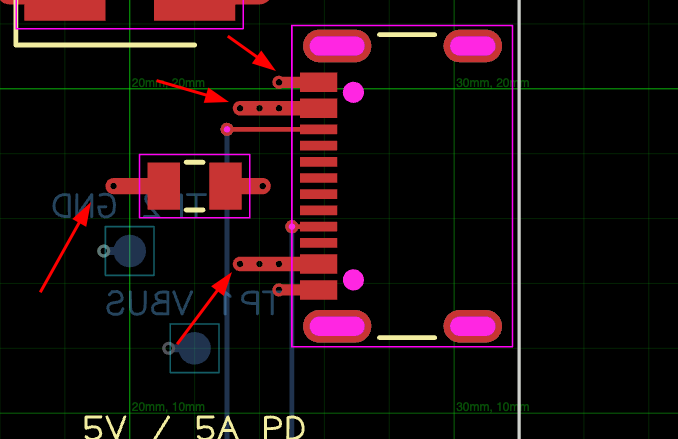
I checked the screenshot against the actual nets:
- Red “fingers” with three black holes: copper connections from USB-C VBUS pads to three vias, which connect to the internal 5 V plane.
- Single holes near the outer USB-C pads: ground vias connecting to the internal ground plane.
- Extensions beside the capacitor: its power and ground connections to those planes.
- Large blue circles labelled GND/VBUS: underside test pads.
The internal planes aren’t visible in this view, so these connections can look like dead ends. The manufacturing export uses ordinary through-vias.
There is a worthwhile review point here: the power connections could be made more compact, and their trace necks, via count and copper plating need a current/temperature assessment. Three vias alone do not establish a 5 A rating, and clean DRC doesn’t establish that either.
My recommendation is to keep four layers for the first prototype, review those power connections, and treat two layers as a separate cost-reduction redesign if the saving justifies it. The screenshot itself doesn’t show missing components or disconnected power connections.```
Want to add to the conversation?
Reply in Discord so your notes stay connected to the source.